

Background
As battery energy storage systems (BESS) become more widely used, accurate state-of-health (SOH) prediction matters for grid reliability and operating costs. Existing deep-learning approaches face two challenges: modeling complex dependencies in long time series and capturing interactions among battery variables.
Model Design
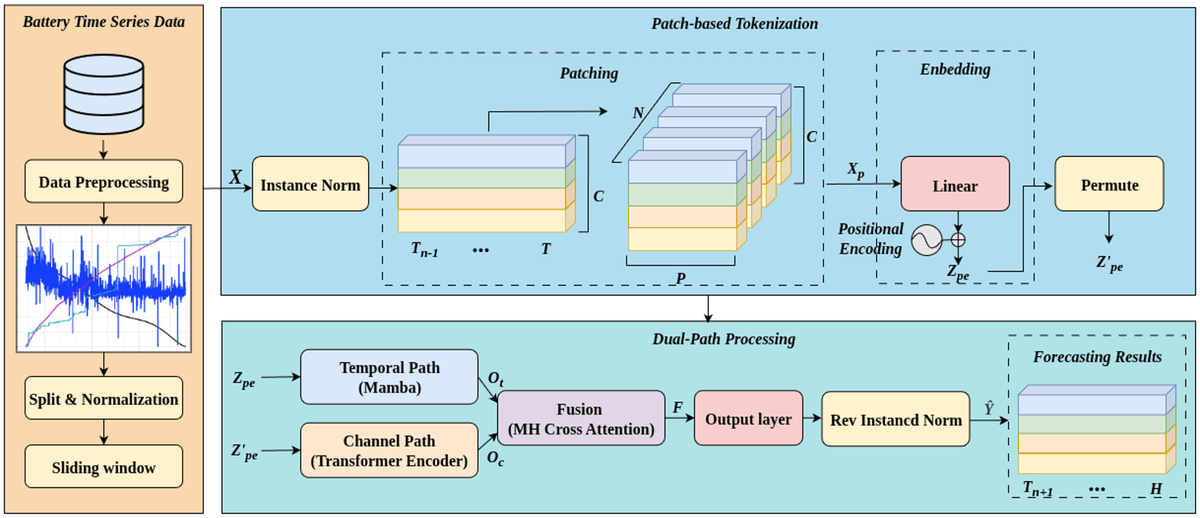
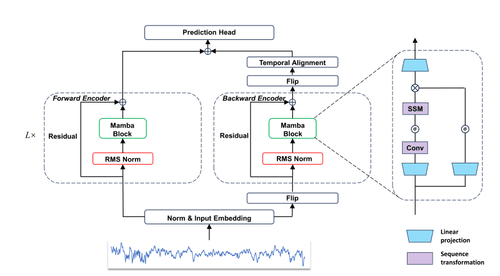
Mamba-Timeformer is a hybrid dual-path deep-learning architecture for BESS battery SOH prediction. Its temporal path uses a Mamba state-space model to process long sequences with linear computational complexity while preserving global modeling. Its channel path uses multi-head attention to capture relationships among battery variables. Cross-attention fusion combines complementary temporal and channel information to address the limitations of single-path approaches. Experiments use real BESS operating data over prediction horizons of 60 to 360 hours.
Temporal Path
Uses a Mamba state-space model to process long time series with linear computational complexity.
Channel Path
Uses multi-head attention to model interactions among battery variables.
Cross Attention Fusion
Combines complementary information from temporal and channel paths for long-term forecasting.
Results
For the 360-hour prediction task, the recorded MAE is 0.96, MAPE is 2.72% and RMSE is 3.40. These values assess dual-path prediction errors under seasonal and usage-pattern changes and provide comparison baselines for subsequent BESS maintenance research.
research architecture